José Carlos Romero: Portrait of the young artist and his “Little Da Vincis” project
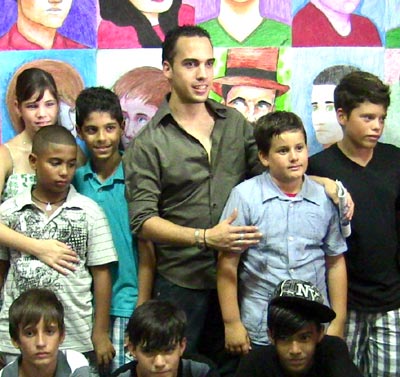
The artistic and educational work of José Carlos Romero is already leaving its mark on the visual arts in Cuba. This young man—only 22 years old, a graduate of the San Alejandro Academy of Fine Arts—has developed an interesting approach to teaching drawing techniques to children between the ages of 6 and 12. The results obtained during 2013 and 2014 are eloquent: 80 students attended his workshop, and he also organized a total of six exhibitions, which included more than 150 Little Da Vinci drawings.
The first of these exhibitions took place at the ARTEX store on Acosta and 10 de Octubre Streets in 2013. The exhibition was themed “Hands and Portraits,” and featured a total of 51 pieces. The success of the exhibition motivated Romero’s work, and throughout 2014, he received several requests, which resulted in five new exhibitions in different locations in Havana: two at the Hotel Habana Riviera and the others at the Hotel Armadores in Santander, the Casa de Asia Museum, and the National Museum of Fine Arts. Of particular impact was the exhibition related to the Capablanca In Memoriam Tournament at the Hotel Habana Riviera, which included 41 drawings of chess pieces. This proposal fostered the interweaving of art and sport, fostering enthusiasm for the so-called science of the game and thus contributing to the comprehensive development of students. The Japanese Culture Day in Cuba was the ideal setting to exhibit 25 new drawings at the Casa de Asia Museum, under the theme “Manga and Anime,” a topic that broadened the range of visual references for young people.
The year 2014 closed with a flourish for Carlos Romero, with an exhibition at the National Museum of Fine Arts. The twenty drawings selected, drawn from the collection of pieces created by his students, revolved around the theme “Urban Landscape / Drawings of Different Views of the Museum Facade.” They showcase the results of his method and dedication, which will spark growing interest among the public interested in developing the next great artists of the visual arts in Cuba and, consequently, the future of Cuban culture. The works exhibited were primarily based on the technique of “colored pencil on white cardboard” and a variant of “tempera and colored pencil on brown cardboard,” with a noticeable mastery of academic drawing by the students, under the aegis of the artist and professor we interviewed today.
Q/ How and when did your interest in the visual arts, particularly drawing, arise?
A/ My interest in drawing began at a very early age, motivated by the visual stimulation of the gigantic, colorful cartoon characters my mother drew on my bedroom wall when I was about 12 months old. I know from her anecdotes and from the drawings she keeps, recording the month and year, that I began drawing when I was two years old. As a child, I always preferred a Crayon to a stroller. While my friends went out to play, I would sit for hours at a table full of crayons and blank paper. To this day, not a single day goes by without me drawing, even on one occasion when I fractured the wrist of my right hand, which I drew with my left hand.
Drawing interests me greatly because it is the foundation of the visual arts: in the sense that it is impossible to be a good painter, a good sculptor, or a good engraver without first being a good draftsman. A drawing is the beginning of an idea; the Mona Lisa was a drawing before it was a painting. In all fine arts academies around the world, regardless of the teacher’s specialty, drawing is a required subject.
Q/ The San Alejandro Academy is highly regarded both on and off the island. From a personal perspective, what experiences were vital to you during your formative years there?
A/ The school’s art teachers were very approachable. It was possible to approach them outside of class with projects and questions. The informal dialogue resulting from these encounters was a very enriching experience. In addition to offering their perspective as teachers, they spoke to us from their perspective as creators, as they were all active artists with internationally recognized works of art. Another decisive factor was the student meetings in the hallways to exchange information, where relevant topics were discussed with the energy and boldness of youth. The school also had a wonderful library with a vast collection of art books that were accessible at any time of day. It was one of the spaces I visited most in my free time, not only to read but also to draw, take notes, and think quietly.
School didn’t just teach us how to draw and paint well; it taught us how to develop artistic research and question established concepts. When it came to presenting a project, we had to do a lot of research and reading, paying attention not only to the technical but also the conceptual aspects of a piece: its background, the context in which it worked, whether your objectives were communicated by it, and other questions, almost like a thesis. Repeating this work process developed an elaborate thought process that extended to other aspects of our lives, making us mature and responsible, despite our age.
Q/ Why did you choose working with children as one of the fundamental paths of your professional development?
A/ Children are geniuses by nature. It has been scientifically proven that the brain, from the moment we are born, is learning, so the expression “they are too young to learn this” does not apply to the brain. As science advances and the enigmas of brain function are revealed, it becomes evident that all children have natural tools to develop genius skills. By understanding the areas of brain function, it is possible to enhance, at will, through training, different abilities: such as memory, observation, attention span, etc. Working with children, one learns that their learning capacity is underestimated. This raises two questions: should the educational program for children be rethought? Are we maximizing children’s potential? Working with children to explore their supposed limits is a way to enhance the development of tomorrow’s people, and I consider contributing to this my greatest professional achievement.
Q/ What is the Little Da Vinci project about?
A/ The Little Da Vincis Project is a version of the drawing program used at the San Alejandro Academy of Fine Arts, with general modifications to make it understandable for a 6-year-old child. It works with all children and produces highly noticeable results from the first month. Its name is derived from the great intellectual and scientific personality, Da Vinci.
I’ve been working on this theory for two years, during which time I’ve successfully tested it with 80 children ages 6 to 12. The pinnacle of their drawing progress has been reflected in the exhibitions we’ve organized, which officially conclude the content we’re studying. To date, we’ve held six exhibitions with more than 150 academic drawings created by children ages 6 to 12.
Q/ How did this project come about and what does it mean to you?
A/ The Little Da Vincis Project begins with a question that arises from my academic background: What is the learning limit for a 6-year-old’s drawing? Can a child that age make an academic drawing?
There is a myth surrounding drawing and painting that suggests that drawing is the result of a “special talent” with which one is born as a result of genetic inheritance. This idea is supported by the existence of child prodigies, who from an early age and without prior training possess a profound mastery of this art. So, how is it possible that a group of 80 children aged 6 to 12, who had never drawn before and who come from ordinary families, managed to draw as well as professionals? Do we attribute it to talent, perhaps?
In January 2012, I began this artistic-scientific experiment with a randomly selected group of 20 children between the ages of 6 and 12. From my experience with them over four months, during which they went from drawing like normal children to drawing in a sophisticated way, it occurred to me that it might be possible to enhance this skill in all children. However, I didn’t have the necessary number of students to test this. I then enrolled a new group with a total of 80 children organized into groups of 20. For two years, I taught them everything I had learned at San Alejandro in the drawing specialty, and we have shown their progress in their exhibitions with more than 150 academic drawings made by children between the ages of 6 and 12.
The Da Vinci Method represents a way to awaken the latent genius abilities in all children.
Q/ Do you think there is an optimal age to start learning drawing techniques?
A/ There are different stages of children’s natural learning to draw, depending on their age. At one year old, they begin to make “scribbles,” at two years old, “controlled scribbles,” at three and four years old, “pre-symbolism,” at five years old, “symbolism,” and at six years old, “symbolism with perspective.” It is precisely at this age that the Da Vinci Method can begin to be taught. It is not necessary for children to understand what they are doing, only that they repeat each of the exercises, using mirror neurons, which are responsible for imitation. Through the constant repetition of these exercises, they incorporate the entire working procedure for making a realistic drawing into their subconscious, developing the neural connections necessary to develop the skill of drawing. My experience with children has shown that they achieve drawing skills similar to those of professionals in a very short time. They do not need any prior training; it is enough that they know how to draw geometric figures, which they are already familiar with at their age.
Q/ Your work as a photojournalist has been widely covered in the Italian magazine Internazionale. Tell me about this experience. Do you believe that art should, in some way, reflect reality?
A/ In my opinion, the artist should be a man of his time, in the sense that his work should respond to the issues of the historical context in which he lives. In that sense, I believe it does. However, in art, concepts such as “reality” are subjective and are handled from the perspective of the artist who employs them. In the case of my personal work, my poetic approach is centered on an aspiration toward reality, documenting the customs, folklore, and slang of 21st-century Cubans, paying special attention to those cultural aspects that are not officially recognized as part of the Cuban idiosyncrasy, the underground culture. This perspective of everyday Cuban life, outside of the stereotypical, lends relevance and interest to this topic.
Q/ Have you received any other recognition outside of Cuba? What meaning do you attach to the awards?
A/ Yes, I received a special mention in a comic strip competition held in Spain by the Costa del Sol Hospital in 2013, as part of its Skin Cancer Prevention and Photoprotection Campaign. The title of my work was “Draculini and Company.” It was a comic strip about a vampire who talks to the viewer about the damage caused by overexposure to the sun. It’s interesting to note that the sun also harms humans.
Awards always surprise me, because when I enter a competition, I immerse myself in the creative process, enjoying every stage of the project’s development. So receiving an award for something I had a lot of fun with is always a surprise.
Q/ Have you received institutional support for your project to teach drawing to children between 6 and 12 years old?
A/ The Little Da Vincis Project is not affiliated with any institution and therefore does not receive support from them. The school is my living room; we make the works in the exhibitions with recycled cardboard. The materials we use are third-rate, which does not affect the quality of the work or the artistic teaching. I have not partnered with any cultural entity because the project is still in its infancy, and this research is solely my work. By receiving support from an institution, I would be sharing the copyright.
Q/ Do you think young art is promoted sufficiently in the country?
A/ I think there’s an awareness of the importance of creating spaces for promoting young artists because there are many art schools for adolescents and young adults, not only for the visual arts but also for dance, music, performing arts, etc. The existence of these schools implies the coexistence of places where graduates can present their work; however, the existing ones are not enough, and efforts must be made to develop many more throughout the country.
Q/ After six successful exhibitions showcasing your students’ work and the technical mastery they were able to achieve at such a young age, what projects do you have in mind?
A/ To continue working. Statistically, 80 children doesn’t constitute a significant percentage. Now, together with my wife—also a San Alejandro graduate—we have expanded the enrollment from 80 to 567 new students, ages 6 to 12, working with the entire enrollment of two primary schools in the Habana del Este municipality, in Alamar. During 2015, we will work with these children and document their development. In 2014, we held five exhibitions; my goal for 2015 is to triple that number. The experience resulting from this stage will be decisive for the scientific and artistic maturity of the Pequeños Da Vincis Project and its practicality.